
By Ryan TANG
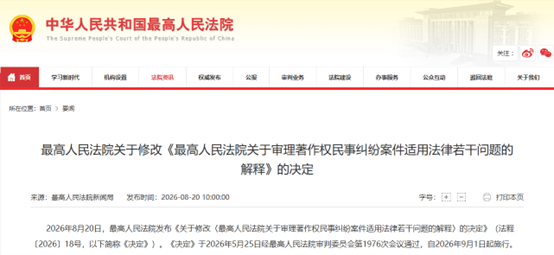
Recently, China’s Supreme People’s Court amended the “Interpretation on Several Issues Concerning the Application of Law in the Trial of Civil Copyright Dispute Cases,” and the State Council’s “Regulations on the Implementation of the Copyright Law (Draft Revision for Public Comment)” is also open for public comment. Together, these two rules send one signal: China’s copyright protection is moving from principled provisions toward scenario-based, granular rules. For foreign companies, this means clearer rights boundaries when creating, using, and disseminating works in China—but also more specific compliance requirements. The following six changes deserve the most attention.
(Source: internet)
1. “Making public” no longer emphasizes “who made it public”
The new rules remove the limitation “by the copyright owner itself or with authorization,” and clarify that “making public” means making a work available to unspecified members of the public, without requiring actual public knowledge. In other words, as long as a work enters a state where unspecified members of the public can access it, it may be deemed public.
Takeaways: Leaks or pirated uploads may also be deemed “making public.” This is particularly relevant to leaks of digital content such as films, games, and software. In enforcement, it is not enough to simply argue that “the public disclosure was not made by us” to deny that the work has been made public.
2. Public place artistic works: indoor venues included, but use is restricted
“Outdoor public places” is changed to “public places,” so indoor venues such as art museums and exhibition halls may also be covered. The public may sketch, paint, photograph, or video-record such works and use the results in a reasonable manner and scope; however, without permission, they may not re-install, display, or publicly communicate them in the same manner.
Takeaways: Taking photos of artistic works in public places for commercial use requires greater caution. Indoor exhibitions, art installations, and similar works may also involve copyright, and authorization should be obtained before commercial use.
3. Statutory license for newspaper and periodical reprinting: digital does not equal “online reprinting exemption”
The statutory license expressly applies to paper newspapers and periodicals, as well as digital versions consistent with their content and layout format. However, reposting between newspapers/periodicals and internet information service providers, and among internet information service providers themselves, does not fall under the statutory license; permission from the copyright owner and payment of remuneration are required.
Takeaways: Online reposting cannot be treated as newspaper or periodical reprinting to enjoy the statutory license. Digital content reposting, aggregation, and media cooperation still require authorization.
4. Architectural design drawings included as architectural works; protection logic between two-dimensional and three-dimensional works is smoother
“The Draft Implementing Regulations” explicitly include design drawings and renderings that represent the exterior appearance of buildings as architectural works, belonging to the two-dimensional form of architectural works; design drawings mainly representing internal practical and functional structures are protected as graphic works.
Takeaways: In the architecture, design, and real estate industries, constructing a building based on design drawings is more naturally understood as reproduction of an architectural work from two dimensions to three dimensions. The protection logic is smoother and infringement findings are clearer.
5. Model works return to the essence of “three-dimensional expression”
The draft removes the phrase “made according to a certain scale.” Model works are three-dimensional expressions formed by abstracting, summarizing, selecting, or transforming an object for purposes such as teaching, research, or exhibition, rather than mechanical scale replicas of physical objects.
Takeaways: In the model, toy, exhibition, and design industries, protected model works are more clearly distinguished from mere physical replicas. Not all scaled-down replicas automatically constitute model works.
6. Payment mechanism for statutory license fees remains disputed
The draft proposes that where works are used under statutory license, royalties should be paid to right holders through copyright collective management organizations within three months from the date of use. However, not all right holders have joined or are willing to join collective management organizations.
Takeaways: If using works under statutory license, attention should be paid to payment channels and timing. How right holders not affiliated with collective management organizations receive remuneration, and how users fulfill their obligations when payment through collective management organizations is not possible, still need further clarification. As this is currently a draft, uncertainty remains.
Overall impact
China’s copyright protection is becoming more granular—both an upgrade in protection and a compliance challenge for foreign companies. It is advisable to update copyright contracts, content review, and licensing strategies, with particular attention to digital content, public art, architectural design, and model works.

Ryan TANG
Partner
Attorney-at-Law
Trademark Attorney
Email: Tangjingyuan@chinantd.com
Mr. Ryan Tang focuses his practice on intellectual property, civil and commercial dispute resolution, and competition law. He also possesses extensive hands-on experience in cross-border legal services, corporate compliance, and transaction licensing. Over the years, Mr. Tang has consistently provided comprehensive legal services to numerous internationally renowned companies. Acting as lead counsel, he has represented clients in hundreds of cross-border intellectual property as well as civil and commercial litigation matters across China.
Widely recognized as a research-oriented lawyer with extensive publications, Mr. Tang places strong emphasis on the integration of legal theory and practice. He has developed a systematic and in-depth understanding of cutting-edge intellectual property issues and complex dispute resolution strategies, enabling him to deliver forward-looking, highly practical, and comprehensive solutions to matters involving intricate factual and legal issues. His professional capabilities and judgment have earned the long-term trust of his clients.
